
 Download Cooke's A Book of Dovecotes as a pdf file
More recent titles to Consider:
The Doocots of Moray: Elizabeth Beaton
Scottish Garden Buildings: Tim Buxbaum
Scottish Doocots:Tim Buxbaum, Shire #190
A Dovecote Heritage: Peter and Jean Hansell
Dovecotes: Peter & Jean Hansell Shire # 213
Doves and Dovecotes: Peter & Jean Hansell
Dovecotes: Peter and Jean Hansell, Shire #213
Dovecots of Cabridgeshire: Peter Jeevar
The Dovecotes and Pigeon Lofts of Wiltshire (2011) £7. This is obtainable from Wiltshire Buildings Record at the Wiltshire and History Centre, Cocklebury Road, Chippenham SN15 3QN
Pigeonniers, ISBN-13 9782365416368, 2015 Lotois
The Dovecotes of Suffolk: John McCann
The Dovecotes of Historical Somerset: John and Pamela McCann,
2003
Dovecotes and Pigeons in English Law: Ancient Monuments Society
V44, 2000: John McCann
An Historical Enquiry into the Design and Use of Dovecotes, Ancient
Monuments Society, V35, 1991 John McCann
The Dovecotes of Rutland, Transactions of the Ancient Monuments
Society, Volume 50, 2006, John McCann
Scottish Dovecotes: G.A.G. Peterkin
Dovecotes In and Around Edinburgh: Niven Robertson
Pigeons as a Source of Food in Eighteenth-Century Scotland, Review
of Scottish Culture volume 4, 1998, Edinburgh, pages 89-103, Una Robertson
Yorkshire Dovecotes and Pigeon Lots: Yorkshire Archaeological
Journal V65, 1993: Alan Whitworth
Pigeon-Houses of the Midi Pyrenees RegionThe Dovecotes and Pigeon Houses of Herefordshire by Robert Walker (2010), published by the Logaston Press, Little Logaston, Woonton Almeley, Herefordshire HR3 6QH
Doocots of Stirlingshire, published by Stirling Council Libraries,
2003. Bill Alison Logie. Available at £3.50 from Stirling Council
Libraries, Borrowmeadow Road, Stirling FK7 7TN
The Scottish Vernacular Buildings Working Group is working its way steadily through the Scottish counties with a series of quite inexpensive booklets about doocots, by different authors. So far they have published on Moray, East Lothian, Lanarkshire, and Highland, Orkney and Shetland, to my knowledge - perhaps more by now. They are obtainable from the Secretary of SVBWG, Veronica Fraser, c/o RCAHMS, 16 Bernard Terrace, Edinburgh EH8 9N
Other older Titles:
Dovecotes of Nottinghamshire: John Severn.
Pigeon Cotes and Dove Houses of Essex: Donald Smith:
The Dovecotes of Notts: J. Whitaker
Titles in French
Pigeonniers de France: Dominique Letellier
Pigeonniers de Provence: Jeanne Laffitte
Coloumbiers & Pigeonneirs en France: Pierre Leron-Lesur
Pigeonniers en Midi-Pyrenees Michel Lucien
Titles in Dutch (Netherlands)
DuivenTillen in Drenthe: H. M. Luning
Titles in German Thank you Michael Gerbert
Taubenschläge in zweckmäßiger verschiedenartiger Ausstattung Aretz, Wilhelm
Neuzeitliche Taubenschläge
Taubenschläge und Taubenhäuser bauen Bauer, Wilhelm
Taubenhäuser im nordöstlichen Bayern und im Egerland: Bedal, Karl
Taubenthurm und Taubenschlag: Bender, R
Luftschlösser. Die Taube und ihr Haus: Drexler, Toni and Kammermeier, Alois
Pigeonniers - Colombiers. Taubenhäuser in Frankreich: Eifler, Hanjo
Taubenhäuser, Taubenschläge: Kammermeier, Alois
Taubenkobel in Altbayern:
Taubenschläge in Altba:
Taubenturme in Tinos: Maren Heyne
Taubenkobel und alte Haus- und Dorfbrunnen: Kerscher, Otto
Die Federvieh-Ställe in ihrer baulichen Anlage sowie die vortheilhäfteste Federvieh- oder Geflügelzucht: Klasen, Ludwig
Der Taubenschlag und seine Einrichtung: Klein, Erich
Die Taubentürme von Agypten: Manger, Reinhard
Taubenzucht und Taubenschläge: Münter, Walter
Etwas über den Wert, Einrichtung, und Bau von Taubenschlägen: Orfert, F
Neuzeitliche Taubenzucht und Taubenschläge: Schemminger, Klemens
Altdeutsche Taubentürme: Schütte, Joachim
Österreichische Taubenkobel: Swoboda, Otto
Historische Taubenhäuser in Norddeutschland unter Berücksichtigung ethologischer und haltungsgeschichtlicher Aspekte: Temme, Sabine
Bau und Einrichtungen moderner Taubenschläge Trübenbach, Paul
Der Taubenschlag oder die Wartung, Pflege, Paaren und Brütezeit der Tauben: Woltmann, JJ
South African
Cape Dovecots and Fowl-Runds: James Walton
Most of these dovecotes were designed to hold between 200 and 500 pairs, and sometimes there were more than one dovecote on the premises. The residents would do what pigeons really do best, fly, feed and breed. These birds, you see, were foragers. Each day they would leave their cotes, scouring the countryside for seeds, weed as well as crop. And, as mentioned earlier, interference was prohibited. So about every six weeks, for nearly the entire year, each pair would offer their young to the cause of gastronomical delight. But pigeons were useful even beyond that of the table. The manure is of very high quality and would fetch a nice price and was also used as a tanning agent for certain leathers. Small wonder then, that these structures were well built and many, to our delight, still stand today.
As alluded to, the Roman columbarium is the antecedent of the English dovecote. Roman columbariums were usually round with a vaulted roof and of stone, though tiled roofs are known to have been used. The entrance door was small, and a "window" of some type allowed entry for the birds, while simultaneously ensuring the birds against the invasion of snakes and other vermin. The interior surface of the walls was covered with a smoothly worked cement made from ground marble. The nest holes were fitted into the interior walls from floor to roof. This basic design traveled from Rome to France and on to England, with the earliest examples being nearly replicas of the old Roman designs.
The best chronicler of dovecotes in Great Britain was Arthur O. Cooke. To him we are indebted for A Book of Dovecotes, published in 1920. Therein, he describes nearly 250 dovecotes extant at that time. Unfortunately, he reports that thousands had been lost and many of the remaining examples were in very poor condition. Even in 1920, nearly none were in use for their intended design. But things look better for dovecotes in Great Britain today. The dovecotes are now protected by law and must be maintained. Many owners and organizations of late understand their historical value and have actually spent large sums in their restoration.
 |
CoteheleOne of particular beauty in style and location can be found at cotehele. cotehele is owned by the National Trust, an English non-profit organization dedicated to the preservation of British heritage. This beautiful structure sits in the garden of the main cotehele mansion and is again home to many pairs of field foraging white pigeons. This particular cote, while not one of the largest to be found, is by no means small. The walls are made of stone nearly three feet thick. There are thirteen rows of nest holes from the floor to the top of the wall, and 30 holes in each row, making for just under 400 nest holes. The nest holes, rather than being set in a direct line, are offset, giving the visual effect of a checkerboard.The nest holes are about six inches square at the opening and enlarge toward the rear in a sort of "L" or pie shape, where the top of the "L" is the opening. Each nest is about 18 inches deep and 12 across at the back The direction of the "L" alternates between each row to provide greater structural integrity to the walls. The roof is dome shaped and constructed of stone slates, topped with a cupola which provides the pigeons light, air, but most importantly ingress and egress |
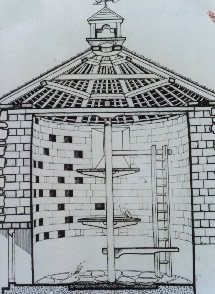 |
While visitors are generally not permitted inside the dovecote, one can peek through the small door and see the arrangement inside. The interior of this particular specimen is also in excellent condition. In fact the "potence" has been restored and is in perfect working order. A potence is a device used to collect the squabs. It consists of a large revolving beam in the center of the cote, from floor to roof. Attached to this beam are two arms that extend outwards almost touching the wall, which makes the upper part appear a bit like a gallows. There is an arm near the top and one near the bottom. At the end of these arms, near the wall, a ladder is attached. This permits a person on the ladder to climb up and down and reach all the nests located on the interior wall, and pull themselves around reaching all of the nests. An ingenious contraption particularly well suited to the round construction. One cannot help but wonder if the potence was thought of first and the cote built in a circular shape to capitalize on the idea, or if the round cote was built first and then the potence sprang to mind.It was in all probability the latter, but the idea of the former still appeals. The drawing of the potence here is very similar, except that is has two platforms in addition to the two arms. While the potence at cotehele does have a platform, it is attached to and part of the lower arm. Perhaps the platforms were used to hold a basket or other tools by the caretakers and without doubt as additional perching space by the birds. |
 |
Round DovecotesNot far from cotehele is another National Trust property, Anthony House. Here you can find two dovecotes. One, a very large round brick structure near the house, stands on the rear lawn. The roof is of slate and the cupola is of wood. Inside you will find the potence to be very similar to the drawing, with two "perching" platforms attached to the potence. The dovecote is very spacious and properly occupied. The walls are three feet thick and the interior diameter is approximately twenty feet. Height to the eaves is also about twenty feet. The nest box arrangement consists of fifteen rows of fifty nest holes in a column arrangement for a total of 750 nest boxes. While the residents of this dovecote still fly in and out freely, the other dovecote, unfortunately, lies in ruins. Only the thick circular stone walls of the ruin remain, telling the story that this too must have been an impressive structure in its time.The wall that remains, complete with nesting holes in the "checkerboard" pattern, is nearly four feet thick and twelve feet high. No trace of the roof remains. It must have collapsed long ago, and the stones carted off for other uses. Even though these circular designs with their potences are marvels beauty and function, not all dovecotes were constructed in this ingenious fashion. Many other shapes are to be found. |
 |
Square DovecotesThe most common shape, next to the circular, is nearly square. In a few of these a potence was also installed, but what worked flawlessly in a round structure must have missed the mark.Hawford dovecote, also owned and maintained for us all by the National Trust, lies about three miles north of Worcester. It is a square structure, in the vernacular of the area called a black and white, and is made of wood and stone. It has four gables in the roof, each one with a small window for additional light. The pigeons used the cupola on top for ingress and egress. Another very unique feature of this dovecote, are the nest boxes. Rather than being built directly into the stone wall, they are made of wood and attached to the walls and even extend into the gable ends. The nest boxes are only about a foot deep off the wall, but gain size by running at a 45 degree angle to the wall, making each nest box about 18 inches deep. On each course the angles run in opposite directions. |
If you would like to learn more about these beautiful dovecotes of Great Britain, get a copy of Arthur Cooke's book, A Book of Dovecotes, and/or continue to visit the Pigeon Cote web site where we provide more and continuing in depth coverage into the future. The Pigeon Cote will be "following" Mr. Cooke as he travels trough England, providing insight as to the current state of affairs of the dovecotes he encountered, complete with pictures, and more. We have added a chapter not included in Cooke's work titled elsewhere in England to cover locations he just did not get to and would not fit neatly into the near London chapter.


