

DevonshireContrary to expectation Devonshire, a county otherwise so rich in history, legend, ancient monuments of many kinds, yields but a poor return so far as dovecotes are concerned. It is extremely difficult to understand why Devonshire should have possessed few dovecotes; equally difficult to know why, if they once existed, they should have so largely disappeared. The fact remains, the explanation rests obscure.While Mr. Cooke was not able to locate many dovecotes
in these counties, and provides us with no drawings or photographs of the
ones he does chronicle, our luck was a bit better. One of the most beautiful
of all the dovecotes we found during this journey was located at Cotehele,
which is a National Trust
property; this dovecote graces the opening page of this series,
and will also be noted below. Don't despair, there are many lovely
examples of dovecotes in these counties and several that are within
easy reach of the avid dovecote admirer . Still, that county which, to many persons other than its own inhabitants, will ever be the best loved in all England, is not entirely without examples. At Powderham Castle, near Exeter, the seat of the Earl of Devon, a field contains an ancient dovecote standing near the Exeter to Dawlish road. The field is known as "Pigeon Vale"; but as a human family of Pigeons has for long resided in the parish, it is most probably to them, and not to the old building's former occupants, the name is due. |
|

|
The dovecote is also locally known as the "Round
House." It is a circular brick building of considerable size, and is now
converted into a cottage. Needless to say the nests have disappeared, and
the structure cannot be regarded as any very great "find" by the dovecote
enthusiast. We found this former dovecote on a small road that turns
to the east off the A379, south of Exminster. The sign is labeled "Powderham
1 1/4." The structure stands in a field to the east of the road. It is clearly
still in use as a cottage, but it is easy to see that
. it was once a dovecote.
Unfortunately, a rectangular addition has been added to one side. From what
Cooke said about its conversion we did not attempt to gain entrance. September
15, 1998 it was once a dovecote.
Unfortunately, a rectangular addition has been added to one side. From what
Cooke said about its conversion we did not attempt to gain entrance. September
15, 1998 |
|
|
|
 |
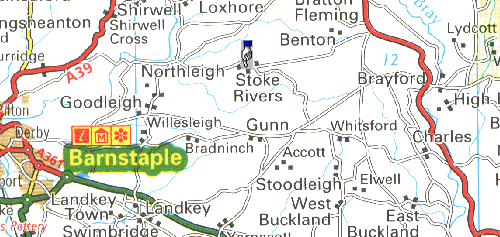
Stoke RiversAway in the north of the county, at Stoke Rivers, near Barnstaple, the rectory garden has a dovecote which, like the hero's helmet, has been converted to "a hive for bees"; the late incumbent, a whole-hearted apiculturist, having made it the headquarters of his hives. It is a small octagonal building of stone, with a thatched roof.We found the charming village of Stoke Rivers on a quiet
morning. A lady pushing a baby carriage directed us to the Old Rectory. We
boldly knocked at the door, and inquired about the dovecote. A very nice
woman, who introduced herself as Roz, invited us through the house and into
the garden to see the dovecote. It is as described by Cooke, with platforms
to hold hives in place below the roof , but bees are not kept there any more.
Windows have also been added. The dovecote is in good shape, and Roz said
they'd
 had it re-thatched a few years ago. The house was built in 1855, and
the dovecote is probably the same age. We had a pleasant time talking about
the dovecote, life in a small village, and Bill Clinton, while we drank coffee
in the garden. Should you read this piece, Roz, thank you so much for your
hospitality. September 23, 1998. had it re-thatched a few years ago. The house was built in 1855, and
the dovecote is probably the same age. We had a pleasant time talking about
the dovecote, life in a small village, and Bill Clinton, while we drank coffee
in the garden. Should you read this piece, Roz, thank you so much for your
hospitality. September 23, 1998. |
|
|
|
KingsbridgeWe are better rewarded at Buckland-tout Saints, a village near Kingsbridge, where, in the garden of the mansion-house, there is a good example of a Devon dovecote, built of stone and "cob." It is circular, with an inside diameter of fifteen feet, a thatched roof and dormer windows. The outer surface of the walls is ivy-covered, and the inside boarded over. The walls are very thick, the doorway noticeably small and low.The owner has adapted it as a game larder, a modern purpose for which such a building, little affected by changes of external temperature, is by no means ill-suited. Nor need we look upon the change as being in any way a desecration. Was it not once the rearing-house for future food? It has today advanced a stage in that food's history, slightly changed its nature - nothing more. And if, as in this case, the change insures the building being kept in good condition and repair, what could we well desire further. Unfortunately, we can not comment on this
dovecote, as our journey did not take us to Buckland-tout Saints. Perhaps
another reader could provide the missing details. |
|
 |
PlymouthAt Warleigh House, Tamerton Foliot, near Plymouth, is a good circular brick dovecote; the doorway, high and narrow - six feet high by two feet nine inches wide - is of granite The building has a high-pitched roof of slate; with open cupola upon the top. The walls are nearly three feet thick, and over twenty feet in height. There are nearly five hundred nest-holes, and the former presence of a potence is made clear by the survival of the granite base which took the lower socket of the upright beam. Some portions of the dwelling-house date from the reign of Stephen, and the dovecote is quite probably of little less antiquity.This dovecote took a little searching. We found Tamerton
Foliot, but no sign of a dovecote. After driving through the village a couple
of times, we stopped at an old peoples' home to ask for directions. One of
the nurses directed us to the dovecote, which was down a . lane that went toward
the west out of the north end of the village. Our directions were quite good,
and after several turns, we arrived at the dovecote. It is as described by
Cooke, but the roof has fallen in, and it is in a very awful state of disrepair.
Oddly, there are two doors, one with a granite surround, and the other with
a more conventional arched brick lintel. September 14, 1998 lane that went toward
the west out of the north end of the village. Our directions were quite good,
and after several turns, we arrived at the dovecote. It is as described by
Cooke, but the roof has fallen in, and it is in a very awful state of disrepair.
Oddly, there are two doors, one with a granite surround, and the other with
a more conventional arched brick lintel. September 14, 1998 |
|
|
|
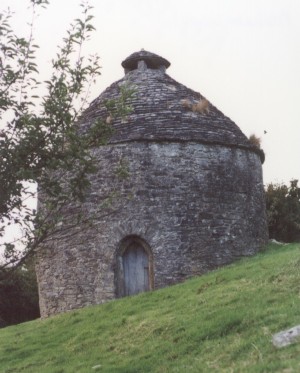 |
PridhamsleightOne of the best of Devonshire dovecotes stands in an orchard of comparatively modern growth at Pridhamsleigh, Ashburton. The building, seemingly of Norman date, is circular and built of stone. The height to the eaves is fifteen feet, and the circumference more than sixty. The domed roof, with a stone coping, has in the centre a circular opening, two feet six inches in diameter. The doorway, five feet high and two feet broad, displays a pointed arch and chamfered edges to the jambs; the walls are three feet thick. Inside there are eleven tiers of oblong nest-holes, about two hundred and fifty in all. Only a few of the upper nests have projecting slates as alighting-ledges. The building is much overgrown with ivy.This dovecote is actually visible from the eastbound
lanes of the A38 dual carriageway. The road to it turns off the Ashburton
to 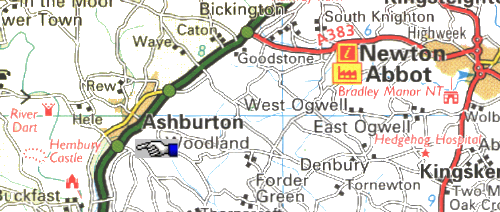 Buckfastleigh road about one mile southwest of Ashburton. The road goes
over the dual carriageway, and the dovecote is immediately on the left. It
is a lovely structure, and the setting would be lovely too, were it not for
the incessant and loud traffic noise. The site is still an orchard, as it
was in Cooke's time. A sign outside the dovecote says that it was restored
in 1976/77 by the Ashburton and Totnes Amenity Society. It is in very good
condition, except for a few plants that have started to grow on the exterior.
September 15, 1998 Buckfastleigh road about one mile southwest of Ashburton. The road goes
over the dual carriageway, and the dovecote is immediately on the left. It
is a lovely structure, and the setting would be lovely too, were it not for
the incessant and loud traffic noise. The site is still an orchard, as it
was in Cooke's time. A sign outside the dovecote says that it was restored
in 1976/77 by the Ashburton and Totnes Amenity Society. It is in very good
condition, except for a few plants that have started to grow on the exterior.
September 15, 1998 |
|
|
|
| Passing now to Cornwall, we find a dovecote at the house of
Garlenich, near Grampound. The building, standing just inside the entrance
gate, is dated 1714. It is of brick, octagonal, with a thatched roof, and
contains about two hundred nests. The walls are twenty feet in height to
the eaves. We got directions to this house from a girl who worked
in a butcher's shop in Grampound. Although we found the house, there is no
dovecote there now. We met an elderly neighbor, who had never heard of there
being a dovecote at Garlenich, although he told us about the one at Antony
House. which is described later in this chapter. September 19,
1998 .
CulveryOf much greater interest is the very ancient "culvery," the local contraction for "Culverhay" (culver = pigeon, hay = a house or homestead) existing at Trevanion, near Wadebridge. It is a circular structure, built of stone and earth, in which no signs of lime or mortar, as we know it, can be traced. The internal diameter is eleven feet, the height of the walls eighteen, and the size of the doorway six feet by three.The roof, also of stone, is domed after the fashion of the earlier Norman examples. In the centre was originally the circular hole seen in so many dovecotes of this shape and type; but, in this instance, above the hole was a stone, supported on pillars. The pillars have been later removed, and the stone placed flat upon the hole, thus closing it. This would, apparently, close the building's career as a pigeon-house. But, here, as at Angle Hall in Wales, we find that several holes pierce through the walls, providing entrance for the birds. It is interesting to find that this curious plan, which was clearly never followed as a general rule, should be adopted alike in southern Wales and Cornwall, districts linked in other ways. Other holes, near the top of the walls inside, were seemingly designed to support the horizontal beams to which was secured the upper end of the potence, which, the centre of the roof being open, could not be supported at that point. |
|
 |
Another curious feature of this very interesting
dovecote is the relatively small number of the nests - one hundred and thirty
only - wholly disproportional to a building of its size. Was there some
regulation in the district, limiting the number of birds kept? But if such
regulation dated from the period of the dovecote's first erection, why then
was it built upon so large a scale? We found this dovecote, now in the town of Wadebridge,
after a little detective work. Our map did not show a village called Trevanion.
We tried Trevanson, with no success, then returned to Wadebridge, where we
asked a girl in a chemist's shop if she had heard of it. She had not, but
an older woman directed us to Trevanion Road, which we thought was worth
a try. As we drove along it, we saw a street called "The Culvery" turning
off to the east. We knew that culvery was a an old Welsh name for a dovecote.
We 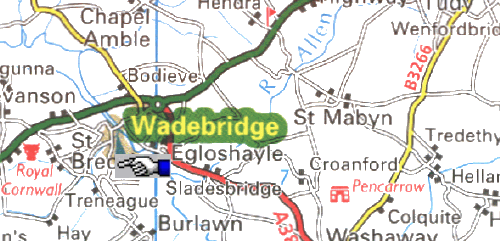 followed the street to the end, through a very new-looking housing
development, and there was the dovecote! The turn is about a half mile from
the old bridge in the center of town. The dovecote is lovely, made of flat
slates, with a domed roof, as Cooke described. We counted 160 nest holes.
The flat slab now only partially covers the roof hole, and there was evidence
that some pigeons had been living there recently. September 20, 1998. followed the street to the end, through a very new-looking housing
development, and there was the dovecote! The turn is about a half mile from
the old bridge in the center of town. The dovecote is lovely, made of flat
slates, with a domed roof, as Cooke described. We counted 160 nest holes.
The flat slab now only partially covers the roof hole, and there was evidence
that some pigeons had been living there recently. September 20, 1998. |
|
|
|
 |
TrevanionThis dovecote at Trevanion is, although much overgrown with ivy, still in excellent repair, and an object of keen interest to its owner. The same is happily the case at the vicarage, Trevena, where a very similar dovecote is still used for its original purpose. It is a little larger than the one just noticed, has more nest-holes, and is particularly worth seeing as still showing the original arrangement of the opening in the roof; the aperture being covered by a slab supported on three stone pillars.We were feeling quite confident about our ability to find dovecotes after finding the one at Wadebridge; however, we had little hope of finding the one at Trevena, since not only was it not on our map, but no nearby village was mentioned that would help us find it. Thinking we would have to give up on this dovecote, we decided to visit Tintagel. Arriving there, we were stunned to learn that the former name of Tintagel was Trevena! We asked directions to the rectory, and the owner kindly let us look at the dovecote in the garden. It is very similar in design and materials to the Trevanion dovecote. September 20, 1998. Starting on October 1, 2008 C. J. Canner emailed us and informed us that this was his home between 1950 and 1976.
He noted that It has survived in modern times because the vivarage and its outbuildings were maintained by the
Diocese of Truro.Presumably the original purpose of the pigeons became unnecessary in the 19th century but some
later vicar introduced a few>The birds were mentioned in Dovecotes of Cornwall by Charles Henderson (Essays
in Cornish history). It was first published in 1935 after his premature death and reissued in 1963. He states that
the dovecote at Tintagel has doves in residence in the chapter about 'Cornish culver-houses' at pp. 211-214. He
must have seen it during 1920s or 1930s. This is further confirmed by an article over sixty years ago when Cornwall was the
subject of a guide in the King's England series (edited by Arthur Mee). His brief account of the Tintagel dovecote
is as follows: "... dovecot with 213 nests. Pigeons were flying about it when we called and we saw that
it still has a perch for every bird. The dovecot and the little chapel are both complete and both built
of slate.A great sycamore tree shades the dovecot ..." |
I have a watercolour must be earlier (from the period 1851-1894) and is perhaps the work of the Vicar during that period, the Rev. R. B. Kinsman. He may also have been responsible f Ihave also found also a drawing (1981), a photograph of the building (early 1960s) and mention ofit in the book The parish of Tintagel : some historical notes, 1982, my father (A. C. Canner) included two pages on this building. In 2008 the diocese of Truro has decided to sell Tintagel Vicarage so the situation you described may changebut it does now have listed building status. http://www.heritagegateway.org.uk/Gateway/Results_Single.aspx? |
|
|
|
|
 |
CraftholeYet a third dovecote of this type is found at Crafthole, Whitesand Bay. Here the roof entrance is entirely uncovered. Some other Cornish dovecotes of a similar construction are now more or less in ruins.The Crafthole dovecote sits on a golf course, and has
a stunning view of the ocean. We braved the flying golf balls, and walked
up to  it so we could look inside. It is in good repair, and is used now to
store lawnmowers, hoses, rakes, and such. It is by far the most picturesque
building we've ever seen on a golf course. September 16, 1998. it so we could look inside. It is in good repair, and is used now to
store lawnmowers, hoses, rakes, and such. It is by far the most picturesque
building we've ever seen on a golf course. September 16, 1998. |
|
|
|
 |
CoteheleTwo beautiful dovecotes, not mentioned by Cooke, are found at two National Trust properties, one at Cotehele and one at Antony House. The Cotehele dovecote is of similar construction to the other domed dovecotes at Pridhamsleigh, Trevanion, Trevena, and Crafthole. The Cotehele dovecote, however, has a cupola. It is in a gorgeous setting, near the old stewpond in the garden of the manor house. It is also inhabited by pigeons! We made an appointment to come back later, and were able to look inside, where we found a working potence. The caretaker and
manager of this property were quite amused that two Americans wanted to brave
the pigeon droppings and walk around inside the dovecote. This is by
far one of my top ten dovecotes in Great Britian. Not for its size, but rather
for the most beautiful setting one could wish to linger in. Even without
the dovecote, this is a most serene spot, with it, it is close to heaven.
I became so lost, that I simple forgot to count nestholes, notice their
specific construction, or even the size and height of the dovecote itself. found a working potence. The caretaker and
manager of this property were quite amused that two Americans wanted to brave
the pigeon droppings and walk around inside the dovecote. This is by
far one of my top ten dovecotes in Great Britian. Not for its size, but rather
for the most beautiful setting one could wish to linger in. Even without
the dovecote, this is a most serene spot, with it, it is close to heaven.
I became so lost, that I simple forgot to count nestholes, notice their
specific construction, or even the size and height of the dovecote itself.
|
|
|
|
 |
Antony HouseThe Antony House dovecote sits behind the manor house, and is made of brick. It has a wooden cupola with a pointed roof. At first we thought the cupola had been completely screened off, to prevent the entry of pigeons, but one section had been left open, and pigeons were living inside. Through the door, we could see a little flock of squeakers on the floor. Unfortunately, we were unable to get inside this dovecote.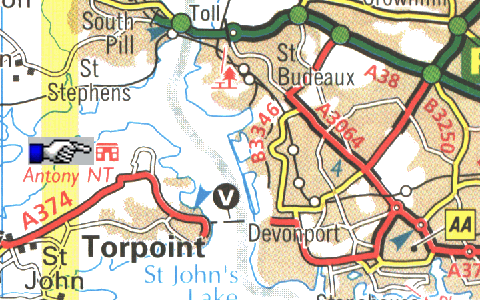 Also at Antony, in the woods near the house, is a much older, ruined dovecote. It is made of flat stones, with buttresses on the outer walls, and the thickness of the walls is easy to see, since they have partially collapsed. |
|
|
|
 |
Blackfordne other dovecote not mentioned by Cooke, is at Blackford, south of Selworthy, in North Devon. It is also owned by the National Trust. We got directions to it from a caretaker at Selworthy. It stands near other farm buildings on a small road. It is of stone, with a conical roof and an interestingly-shaped round opening in the top. There is a good history of the dovecote posted inside.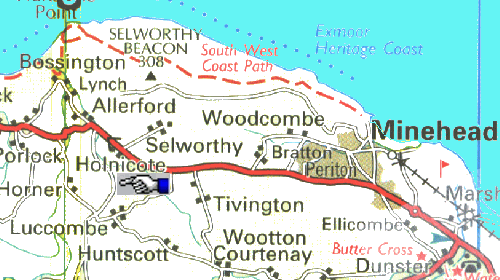 |
 Dovecote: Table of Contents |
 |
 |
 |


